
DNA Sequencing Market Size to Reach USD 40.02 Billion by 2031 as Clinical Diagnostics, Long-Read Platforms, and Precision Medicine Drive Growth
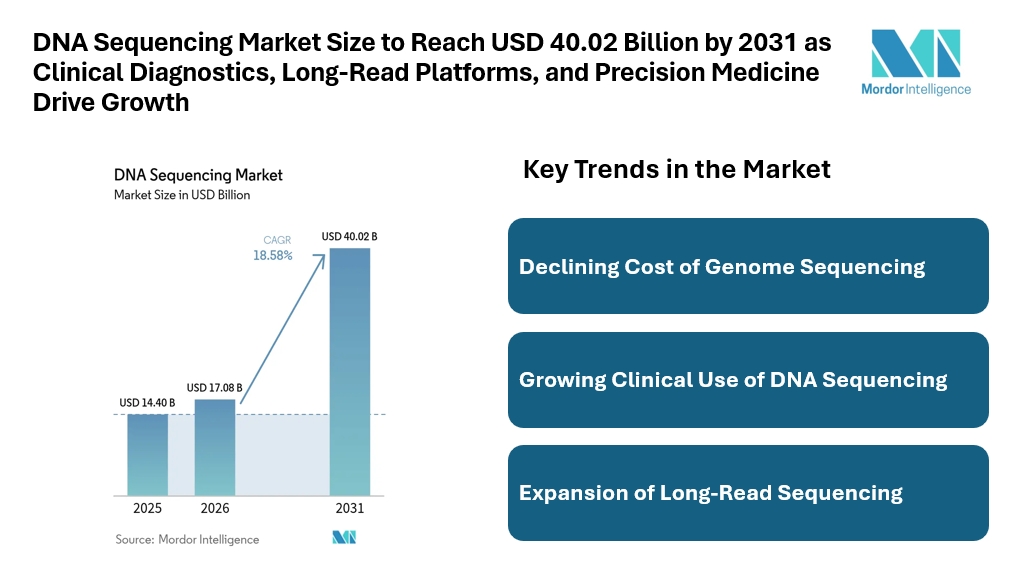
Hyderabad, India – 24 Dec 2026, The DNA Sequencing Market size is estimated at USD 17.08 billion in 2026 and is projected to reach USD 40.02 billion by 2031, registering a CAGR of 18.58% during the forecast period. North America currently represents the largest regional market, while Asia-Pacific is expected to record the fastest growth. Declining sequencing costs, broader clinical adoption, government-backed precision-medicine programs, and growing use of sequencing in oncology and rare-disease diagnostics are supporting market expansion.
DNA sequencing refers to technologies and workflows used to determine the order of nucleotides in genetic material, covering activities from sample preparation and sequencing to data analysis and storage. The technology is increasingly moving beyond academic research into routine clinical testing, drug discovery, population genomics, and personalized medicine. At the same time, high equipment costs, shortages of bioinformatics expertise, regulatory complexity, and supply-chain risks continue to influence adoption across different markets.
Report Overview: https://www.mordorintelligence.com/industry-reports/dna-sequencing-market?utm_source=abnewswire
DNA Sequencing Market Trends
Declining Cost of Genome Sequencing
The declining cost of sequencing is expanding access to genomic technologies across research and clinical environments. Higher-throughput platforms, improvements in sequencing chemistry, and greater operational efficiency are reducing the cost associated with processing genomic samples. This is helping laboratories consider sequencing for applications that previously faced significant economic barriers.
Lower sequencing costs are also supporting population-scale genomics and routine clinical testing. As the cost of generating genomic data decreases, demand is increasingly shifting toward interpretation, data management, and application-specific workflows, creating additional opportunities within the DNA Sequencing industry.
Growing Clinical Use of DNA Sequencing
Clinical diagnostics have become a major source of demand for the DNA Sequencing Market, particularly in oncology, rare and genetic disorders, infectious diseases, and reproductive health. Sequencing can provide information that supports disease characterization, treatment selection, and the identification of clinically relevant genetic variants.
Broader reimbursement and approvals for clinical sequencing are also supporting adoption. Hospitals and clinical laboratories are increasingly incorporating sequencing into diagnostic workflows as platforms become easier to operate and reporting processes become more standardized.
Expansion of Long-Read Sequencing
Next-generation sequencing continues to account for a large portion of the market, but long-read technologies are gaining attention for applications where short-read methods can have limitations. Nanopore sequencing is expected to record particularly strong growth as real-time sequencing and long-read capabilities support structural-variant detection, methylation analysis, and other complex genomic applications.
The development of hybrid sequencing workflows is also expanding the range of applications. Laboratories can combine the established accuracy and economics of short-read sequencing with the additional genomic context provided by long-read technologies, creating opportunities across oncology, rare-disease research, metagenomics, and transcriptomics.
Growing Demand for Sequencing Data Analysis
As sequencing generates larger datasets, data analysis and storage are becoming increasingly important components of the DNA Sequencing Market growth. Cloud-based bioinformatics platforms and automated analysis pipelines are helping laboratories process genomic information without requiring extensive local computing infrastructure.
The need for faster and more consistent interpretation is particularly relevant in clinical applications. Improved variant calling, genomic annotation, and data-management tools can help laboratories translate sequencing results into usable information while reducing manual workload.
Government Precision-Medicine Programs Support Adoption
Government-backed population genomics and precision-medicine programs are expanding sequencing infrastructure and creating demand for instruments, consumables, and sequencing services. These initiatives also generate large genomic datasets that can support research into disease patterns and population-specific genetic variation.
Public investment is particularly relevant in regions where national genomics programs are being developed. Such programs can strengthen sequencing capabilities within healthcare systems and research institutions while creating opportunities for technology providers and service companies.
DNA Sequencing Market Segmentation
By Product & Service
-
Instruments
-
Consumables
-
Services
Consumables represent a major component of the market because sequencing workflows require recurring purchases of reagents, flow cells, and related materials. Sequencing-as-a-service and data-analysis services are also gaining importance as laboratories outsource specialized technical and informatics requirements.
By Sequencing Technology
-
Sanger Sequencing
-
Next-Generation Sequencing (NGS)
-
Illumina SBS
-
Ion Semiconductor
-
Other Technologies
-
Third-Generation Sequencing
Next-generation sequencing remains the largest technology category, supported by established clinical workflows and broad application coverage. Third-generation and nanopore sequencing technologies are expanding the market for long-read applications, particularly where structural variants, repeat regions, and methylation patterns need to be analyzed.
By Workflow Step
-
Sample Preparation
-
Library Preparation
-
Sequencing
-
Data Analysis & Storage
Sequencing represents a core part of the workflow, while data analysis and storage are becoming increasingly important as genomic datasets grow in volume and complexity. Cloud-based infrastructure and automated bioinformatics tools are supporting this shift.
By Application
-
Clinical Diagnostics
-
Oncology
-
Reproductive Health (NIPT, Carrier)
-
Infectious Disease
-
Rare & Genetic Disorders
-
Personalized Medicine
-
Drug Discovery & Development
-
Other Applications
Clinical diagnostics account for a significant portion of demand, with oncology representing an important application. Personalized medicine and drug discovery also continue to use sequencing for patient stratification, target identification, and companion-diagnostic development.
By End User
-
Hospitals & Clinical Laboratories
-
Academic & Research Institutes
-
Pharmaceutical & Biotechnology Companies
-
Other End Users
Academic and research institutes remain important users of sequencing technologies, while hospitals and clinical laboratories are expanding their use as sequencing becomes more integrated into routine diagnostics. Pharmaceutical and biotechnology companies use sequencing across drug discovery, biomarker research, and companion-diagnostic development.
By Geography
-
North America
-
United States
-
Canada
-
Mexico
-
Europe
-
Germany
-
United Kingdom
-
France
-
Italy
-
Spain
-
Rest of Europe
-
Asia-Pacific
-
China
-
Japan
-
India
-
Australia
-
South Korea
-
Rest of Asia-Pacific
-
Middle East & Africa
-
GCC
-
South Africa
-
Rest of Middle East & Africa
-
South America
-
Brazil
-
Argentina
-
Rest of South America
North America represents the largest regional market, supported by clinical sequencing adoption, research funding, healthcare infrastructure, and genomic testing activity. Asia-Pacific is expected to be the fastest-growing region as population-scale sequencing programs, healthcare investment, and genomics research expand across the region.
For more insights on the Japanese market report, please visit the Mordor Intelligence page: https://www.mordorintelligence.com/ja/industry-reports/dna-sequencing-market?utm_source=abnewswire
DNA Sequencing Market Competitive Landscape
The DNA Sequencing Market share is moderately concentrated, with established companies competing across sequencing instruments, consumables, services, and supporting technologies. Illumina maintains a substantial installed base, while Oxford Nanopore and Pacific Biosciences are strengthening competition in long-read sequencing. Other companies are also developing platforms focused on workflow integration, cost reduction, automation, and data analysis.
Competition is increasingly extending beyond sequencing instruments themselves. Companies are developing integrated chemistry, informatics, cloud platforms, and application-specific workflows to address the growing need for faster sequencing and simpler interpretation. Supply-chain resilience and reliable access to reagents are also becoming important considerations for laboratories and technology providers.
Key Players
-
Merck KGaA
-
Thermo Fisher Scientific Inc.
-
Agilent Technologies Inc.
-
Illumina Inc.
-
F. Hoffmann-La Roche Ltd.
-
QIAGEN
-
Danaher Corp. (IDT)
-
Bio-Rad Laboratories Inc.
-
Pacific Biosciences of California Inc.
-
Oxford Nanopore Technologies PLC
-
BGI Genomics Co. Ltd. (MGI Tech)
-
10x Genomics Inc.
-
Eurofins Scientific
-
Macrogen Inc.
-
Myriad Genetics Inc.
-
GenScript Biotech Corp.
Mordor Intelligence identifies Merck KGaA, Thermo Fisher Scientific, Agilent Technologies, Illumina, and F. Hoffmann-La Roche among the DNA Sequencing industry leaders, while noting that its major-player list is not presented in ranked order.
Conclusion
The DNA Sequencing Market is expanding as sequencing moves further into clinical diagnostics, precision medicine, drug discovery, and population genomics. Declining sequencing costs, increasing clinical adoption, government-supported genomics programs, and growing demand for long-read technologies are creating new opportunities across the sequencing workflow.
At the same time, high capital requirements, bioinformatics talent shortages, regulatory complexity, data-privacy requirements, and supply-chain volatility remain important considerations for market participants. The increasing importance of data analysis and cloud-based workflows is also broadening competition beyond sequencing instruments and consumables.
About Mordor Intelligence:
Mordor Intelligence is a trusted partner for businesses seeking comprehensive and actionable market intelligence. Our global reach, expert team, and tailored solutions empower organizations and individuals to make informed decisions, navigate complex markets, and achieve their strategic goals. With a team of over 550 domain experts and on-ground specialists spanning 150+ countries, Mordor Intelligence possesses a unique understanding of the global business landscape. This expertise translates into comprehensive syndicated and custom research reports covering a wide spectrum of industries, including aerospace & defense, agriculture, animal nutrition and wellness, automation, automotive, chemicals & materials, consumer goods & services, electronics, energy & power, financial services, food & beverages, healthcare, hospitality & tourism, information & communications technology, investment opportunities, and logistics.
For any inquiries or to access the full report, please contact:
[email protected] https://www.mordorintelligence.com/
Media Contact
Company Name: Mordor Intelligence Private Limited
Contact Person: Jignesh Thakkar
Email: Send Email
Phone: +1 617-765-2493
Address:11th Floor, Rajapushpa Summit, Nanakramguda Rd, Financial District, Gachibowli
City: Hyderabad
State: Telangana 500008
Country: India
Website: https://www.mordorintelligence.com/


