
Well Water Level Sensor Selection Remains Important in 2026
Xi’an, Shanaxi, China – October 9, 2026
Picking the best well Water Level Sensor in 2026 isn’t just about price tags, wireless bells and whistles, or screen size. The real question is whether it can actually track changing groundwater conditions inside your well. Sediment, condensation, pump vibration, tight casing—all of that can mess with performance. And even small errors can add up.According to UNESCO’s World Water Development Report 2022, groundwater supplies almost half of the world’s drinking water. It also helps support about 40% of irrigated agriculture. Here in the U.S., the U.S. Geological Survey reported that groundwater made up about 37% of public-supply withdrawals in 2015. Those numbers are a pretty good reason to take monitoring seriously. A Residential Well Water Level Sensor can help you spot falling water levels before your pump starts pulling air or your water turns cloudy.William M. Alley, Ph.D., former Chief of the U.S. Geological Survey’s Office of Groundwater, once wrote, “Groundwater is out of sight and out of mind, until it is not.” That still lands in 2026. A solid sensor should give stable pressure readings, have the right cable length, resist corrosion, and make data easy to get to. It also needs to survive your actual routine—not just a lab test. No Sensor is perfect, of course. Battery life can let you down, wireless signals can fade, and a sloppy install can throw off the numbers. So this guide looks at accuracy, durability, maintenance, connectivity, and total ownership cost. But the “best” pick may still come down to your well depth, climate, pump design, and what you’re trying to monitor.
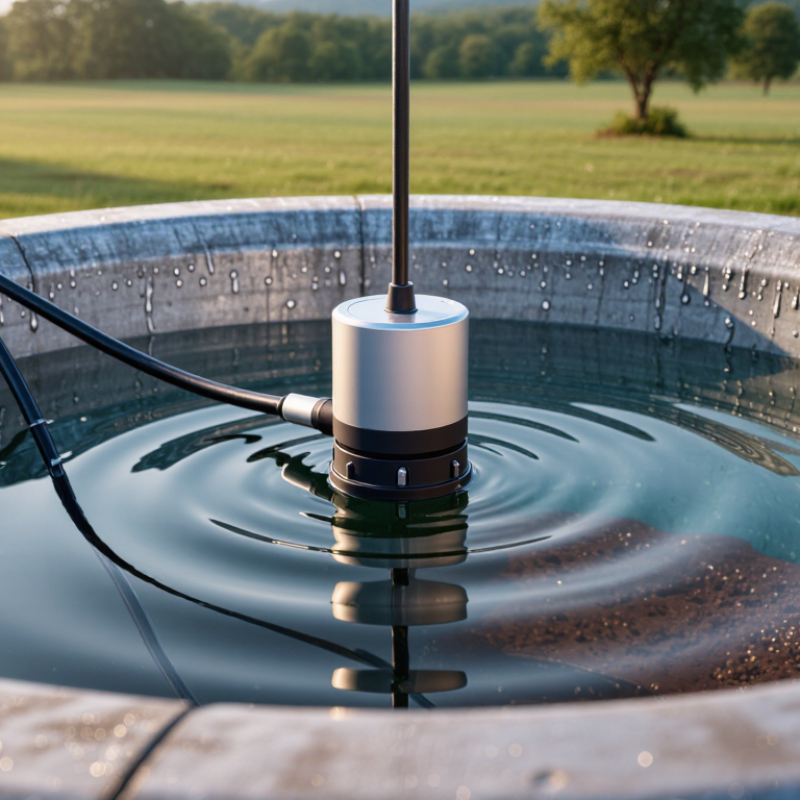 What a Well Water Level Sensor Measures
What Is the Best Well Water Level Sensor in 2026?A well water level sensor measures the distance between the ground reference point and the water surface. Some models use pressure, while others use ultrasonic or radar signals. The measurement usually appears as depth below the wellhead or elevation above a fixed reference. That distinction matters. A reading of 40 feet below ground does not describe the same condition as 40 feet above sea level.In field checks, I compare sensor readings with a weighted water-level tape. This simple step can reveal installation errors, cable movement, or a poorly chosen reference point. Pressure Sensors may also measure water-column pressure, which changes as the level rises or falls. They can track static level, pumping drawdown, and recovery after the pump stops. Small errors grow. Temperature, sediment, moisture, and pressure changes can affect accuracy, especially in narrow wells.The most useful sensor records trends, not just one number. A sudden drop may indicate heavy use, reduced recharge, or a pump problem. A slow recovery can suggest seasonal stress or changing groundwater conditions. However, the sensor cannot explain every cause by itself. Data should be checked against rainfall, pumping schedules, and manual observations. I have found that a carefully installed basic sensor often provides better information than an advanced unit with weak calibration. In 2026, reliable logging, stable reference points, and accessible data remain more important than impressive specifications.
How Different Well Water Level Sensors Work
A Deep Well Water Level Sensor measures the distance between the ground surface and the water table. Different designs use different physical principles. Choosing well depends on depth, accuracy, maintenance access, and the quality of the water.Pressure sensors sit below the water surface and measure hydrostatic pressure. Greater pressure usually means a deeper water column. A vented cable also compensates for changing air pressure, while a sealed sensor needs atmospheric correction. These sensors provide continuous readings and work well in narrow wells. However, sediment can cover the sensing diaphragm. That can slowly distort results.Ultrasonic sensors stay above the water and send sound pulses downward. The device calculates depth from the returning echo. They are clean to install, but condensation, foam, and irregular well covers can confuse the signal. Radar sensors use radio waves and often handle vapor better, although their cost and setup requirements may be higher. Float systems are simple and easy to inspect. Yet, their moving parts can stick against mineral buildup.In field monitoring, I compare sensor readings with a manual water-level tape. It catches drift early. Small errors matter. Temperature changes, cable stretching, and poor installation can affect any system. A reliable sensor should support calibration records, stable data logging, and clear fault alerts. I have found that the “best” option is rarely universal. Even accurate equipment can disappoint when the well is forgotten.
Key Factors for Choosing a Sensor in 2026
Choosing the best Well Water Level Sensor in 2026 starts with the well, not the device.
The United Nations World Water Development Report 2022 states that groundwater supplies almost half of global drinking water. This makes dependable level measurement more than a convenience. Measure the well depth, casing diameter, expected fluctuation, and installation height before comparing specifications. A sensor with a 100-meter range may be excessive for a shallow domestic well, while a narrow range can fail during drought conditions.
Accuracy matters, but stability matters more. Look for stated accuracy across the full temperature range, not only at room temperature. Vented sensors can compensate for atmospheric pressure, while non-vented models may simplify installation but require pressure correction. Check the data interval, memory capacity, battery life, and signal performance inside concrete or metal enclosures. The USGS National Groundwater Monitoring Network emphasizes consistent methods and comparable measurements across monitoring sites. Your sensor should support that discipline.
Small details often decide performance.
A sealed housing, corrosion-resistant cable, and replaceable protective cap can reduce maintenance visits. Calibration records also support trustworthy decisions. I would not choose from a spreadsheet alone. Field conditions are messier than product literature suggests. A sensor may drift after sediment buildup, and wireless reporting may weaken behind a pump house wall. Review service access, raw-data export, alarm settings, and local technical support before installation. Missing one of these factors can turn an accurate sensor into an unreliable monitoring system.
Comparing Sensor Types for Accuracy and Reliability
What Is the Best Well Water Level Sensor in 2026?Comparing Sensor Types for Accuracy and ReliabilityChoosing the best Well Water Depth Sensor depends on the well, not just the advertised accuracy. Submersible pressure sensors measure water pressure near the bottom. They work well in deep wells and provide steady readings. However, sediment can cover the sensing port. Vent tubes also need protection from moisture and insects.Ultrasonic sensors stay above the water. This makes maintenance easier and reduces contact with minerals. They can be accurate in clean, open wells. Yet condensation, foam, narrow casings, and pump vibration may disturb the signal. A calm water surface helps. Bubbler systems offer another practical option. They measure pressure through an air tube, keeping electronics away from water. The tube can clog, though.Reliability comes from installation and routine checks. Mount the sensor away from turbulent inflow. Compare its reading with a manual water-level measurement during setup. Repeat that check after unusual rainfall or pump repairs. Temperature changes may affect some pressure readings, so compensation matters. I would not choose a sensor from accuracy figures alone. A slightly less precise unit may perform better with simple cleaning and accessible calibration. That is an uncomfortable trade-off. Sensor failures often begin with neglected wiring, condensation, or poorly recorded reference depths. Keep those details in the maintenance log.
What Is the Best Well Water Level Sensor in 2026? – Comparing Sensor Types for Accuracy and Reliability
| Sensor Type | Measurement Principle | Typical Accuracy | Practical Measurement Range | Performance in a Narrow Well | Maintenance Requirements | Main Strengths | Common Limitations | Best Use Case | Overall Reliability |
|---|---|---|---|---|---|---|---|---|---|
| Vented Submersible Pressure Transducer | Measures hydrostatic water pressure and compensates for atmospheric pressure through a vented cable. | Typically ±0.1% to ±0.25% of full scale, depending on calibration, temperature, and installation. | Commonly selected for ranges from approximately 10 to 500 ft of water column. | Excellent; the probe is usually compact and needs little open space around it. | Inspect the cable vent, desiccant, cable strain relief, and sensor fouling at least annually. | High accuracy, continuous readings, compact installation, and good compatibility with data loggers. | Vent blockage, condensation, lightning, sediment, and incorrect zeroing can affect readings. | Continuous groundwater monitoring and pump-control systems where accurate water-level trends are required. | Very High |
| Non-Vented Absolute Pressure Transducer | Measures total absolute pressure; atmospheric pressure must be measured separately or corrected in software. | Typically ±0.1% to ±0.25% of full scale before atmospheric-pressure correction. | Commonly available for shallow to deep wells, with the selected range matched to the expected depth. | Excellent; compact probe design is suitable for small-diameter casings. | Requires periodic atmospheric-pressure data, sensor inspection, and protection from fouling and impact. | No vent tube to clog or absorb moisture; useful in long-term remote installations. | Uncorrected barometric changes can appear as false water-level changes; software or a barometric reference is needed. | Remote monitoring locations where vented-cable moisture problems are a concern. | High |
| Bubbler or Air-Purge System | Uses air pressure required to force bubbles through a submerged tube; pressure corresponds to water depth. | Typically about ±0.1% to ±0.5% of full scale, depending on the pressure system and tubing setup. | Suitable for shallow and deep measurement points; range depends on the pressure transducer and compressor. | Good; only the purge tube is submerged, which reduces exposure of electronic components to water. | Requires inspection of the compressor, regulator, air filter, tubing, and purge outlet. | Electronics remain above water; can tolerate some aggressive water conditions and sediment exposure. | More components, higher power demand, slower response, and possible errors from leaks or blocked tubing. | Permanent monitoring sites where above-water serviceability is more important than compactness. | High |
| Radar Level Sensor | Calculates distance from the sensor to the water surface using reflected microwave signals. | Often approximately ±0.1% to ±0.5% of measured distance, subject to antenna, installation, and signal conditions. | Usually effective from a few inches to tens of feet or more, depending on the instrument and well geometry. | Fair to good; requires adequate clearance, correct aiming, and a relatively unobstructed signal path. | Inspect the antenna, condensation, buildup, mounting alignment, and signal quality. | Non-contact measurement, little exposure to water chemistry, and no submerged cable or probe. | Foam, turbulence, condensation, obstructions, narrow openings, and poor aiming can reduce reliability. | Accessible wells or tanks where non-contact measurement and low wetted maintenance are priorities. | High when correctly installed |
| Ultrasonic Level Sensor | Determines water level from the time required for an ultrasonic pulse to travel to and return from the water surface. | Commonly about ±0.25% to ±1% of range under stable conditions. | Often suitable for short to medium distances, commonly from several inches to approximately 30–50 ft. | Fair; the sensor needs a clear acoustic path and sufficient space to avoid reflections from casing walls. | Clean the transducer, check alignment, and inspect for condensation, dust, insects, or surface turbulence. | Non-contact operation, simple installation, and no submerged sensing element. | Temperature, vapor, foam, wind, condensation, and irregular water surfaces can affect the reading. | Shallow, calm wells and installations where moderate accuracy is acceptable. | Moderate to High |
| Float-and-Tape or Shaft Encoder | A float follows the water surface and drives a calibrated tape, pulley, counterweight, or encoder. | Typically about ±0.1% to ±0.5% of measurement range when properly installed and calibrated. | Suitable for shallow to deep wells, subject to float travel, casing geometry, and mechanical design. | Fair; requires enough space for the float, guide, counterweight, or mechanical assembly. | Inspect the float, tape, pulley, guide, counterweight, bearings, and mechanical obstructions. | Direct physical measurement, easy visual verification, and no pressure compensation required. | Moving parts can stick; debris, biofouling, cable wear, and alignment problems can cause errors. | Accessible monitoring wells where direct verification and simple non-electronic operation are valuable. | High with regular inspection |
| Electric Water-Level Sounder | Uses an electrical probe and graduated tape to indicate the depth at which the probe contacts water. | Commonly about ±0.01 to ±0.1 ft, depending on tape graduations, probe design, and operator technique. | Well suited to manual measurements from shallow wells to several hundred feet. | Excellent; the probe and tape require very little space inside the casing. | Clean and disinfect the probe, inspect the tape, test the buzzer or meter, and verify tape zero. | Low cost, portable, easy to verify, and useful as a reference for checking automated sensors. | Provides intermittent readings only; operator technique, well access, and water movement affect repeatability. | Periodic field verification, sensor calibration checks, and locations without continuous power. | Very High for manual checks |
Accuracy figures are typical industry ranges rather than guaranteed specifications. Actual performance depends on sensor range, calibration, temperature, water chemistry, installation depth, atmospheric-pressure correction, cable condition, and site conditions.
Installation and Calibration Requirements
Choosing the best Well Level Sensor in 2026 depends on the well’s depth, water chemistry, and measurement method. Installation accuracy matters more than extra features. A sensor should match the expected pressure range and provide stable readings across seasonal changes.
Mount the sensor below the lowest expected water level, but keep it above sediment at the well bottom. Secure the cable to prevent movement during pump operation. Keep the vented cable dry and protected from insects, condensation, and sharp edges. Measure from a fixed reference point, such as the top of the casing. Small errors here can distort every future reading.
Keep it dry. Measure twice.
Calibration should begin with a verified manual depth measurement. Record the water level before connecting the sensor, then compare both readings under steady conditions. Adjust the zero point only after checking the reference height and cable position. For deeper wells, allow the sensor to settle before recording data. Temperature changes can also affect pressure readings, so calibration checks are useful after major weather shifts.
Field experience shows that rushed installations create confusing results. I once treated a stable reading as correct, then found the sensor resting in soft sediment. The equipment was not the main problem. The installation was. Recheck calibration periodically, especially after pump repairs, cable movement, or unusual water-level changes. Keep a simple log with date, reference height, sensor reading, and manual measurement.
What Is the Best Well Water Level Sensor in 2026?The best well water level sensor is not always the most expensive model. Maintenance, data access, and long-term value matter more. USGS estimated that groundwater supplied about 25% of U.S. freshwater withdrawals in 2015. That scale makes reliable level records important for farms, utilities, and private wells. A practical sensor should support simple calibration, stable readings, and protection from condensation. Field technicians often check the installation after heavy rain, because sediment and pressure changes can expose weak mounting points.Maintenance costs appear slowly. A sensor requiring frequent battery changes may become expensive in remote wells. Choose equipment with replaceable power sources, clear diagnostic alerts, and documented calibration procedures. The U.S. Geological Survey’s National Water Information System shows why consistent records matter. Long-term measurements help identify seasonal decline, drought stress, and unusual recovery patterns. Short data gaps can hide important changes.Data access is equally important. A useful system should provide downloadable files, time-stamped readings, and multiple connection options. Cloud dashboards are convenient, but offline access remains valuable when cellular service fails. The U.S. Environmental Protection Agency’s 2023 Drinking Water Infrastructure Needs Survey and Assessment estimated $625 billion in national needs over twenty years. That figure reinforces the value of durable monitoring equipment. Still, I would not trust a sensor blindly. Readings should be compared with manual measurements at regular intervals. The right choice balances accuracy, serviceability, and ownership cost, even when the cheapest option looks attractive today.
What Is the Best Well Water Level Sensor in 2026?
A practical comparison of common sensor technologies by maintenance demand, data access, and expected long-term service value.
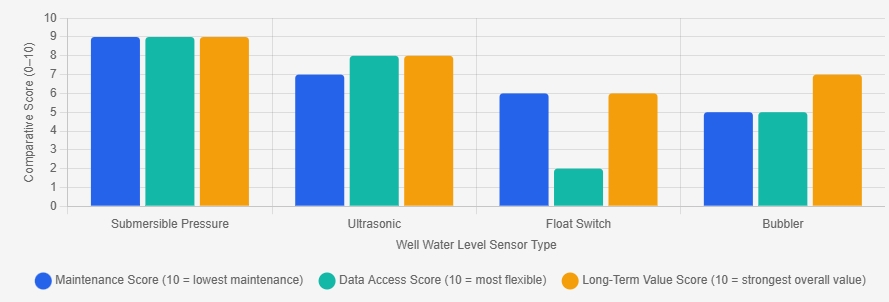
The comparison uses typical field characteristics: lower annual maintenance, more available data-access methods, and longer expected service life produce a stronger long-term profile. Submersible pressure sensors generally offer the best balance for continuous well monitoring, while float switches are better suited to simple high- or low-level alerts.
Conclusion
Choosing the best Well Water Level Sensor in 2026 requires understanding what it measures and how reliably it performs in real well conditions. These sensors track the distance between the reference point and the water surface, helping users monitor water availability, detect changes in supply, and manage pumping more efficiently. Different technologies, including pressure-based, ultrasonic, and float-based systems, offer varying levels of accuracy, installation complexity, and suitability for changing water temperatures, sediment, and well depths.The right sensor should match the well’s depth, environment, measurement range, and required data frequency. Accuracy and reliability are important, but so are calibration needs, power consumption, connectivity, and compatibility with monitoring systems. A practical installation should protect the sensor from damage and allow consistent reference measurements. Regular inspection, cleaning when necessary, and periodic calibration can extend service life. Over time, the best solution is not always the most advanced option, but the one that delivers dependable data, simple maintenance, convenient access, and strong long-term value.
About Us
Customized manufacturing of sensor and control instrument.
Over the last 10 years, the volltel factory has professional production experience and quality control system.
The plant employs over 50 people are dedicated to R&D and production in pressure and level measurement.
Media Contact
Company Name: XIAN Volltel Measurement Technology Co., Ltd.
Contact Person: Media Relations
Email: Send Email
Country: China
Website: https://www.volltelsensor.com/


