
Peripheral T-Cell Lymphoma Market Size in the 7MM is projected to grow at a significant CAGR over the forecast period of 2026-2036 | DelveInsight
(Albany, US), October 19, 2026 – DelveInsight’s ‘Peripheral T-Cell Lymphoma (PTCL) Market Insights, Epidemiology and Market Forecast – 2036’ report delivers an in-depth understanding of Peripheral T-Cell Lymphoma, historical and forecasted epidemiology, as well as the Peripheral T-Cell Lymphoma market trends in the United States, EU4 (Germany, Spain, Italy, and France) and the United Kingdom, and Japan.
Explore the intricate details of the Peripheral T-Cell Lymphoma Market Report @ Peripheral T-Cell Lymphoma Treatment Market Size
Key Takeaways from the Peripheral T-Cell Lymphoma Market Report
-
In June 2026, primary results from the Phase 2 CHEPA trial were presented at the EHA Congress. Evaluating a combination of brentuximab vedotin, CHP chemotherapy, and etoposide for newly diagnosed CD30-positive peripheral T-cell lymphomas, the regimen met its primary endpoint with an impressive 76% complete metabolic response rate and manageable toxicity.
-
In April 2026, Secura Bio announced that the Journal of Clinical Oncology published final results from its Phase 2 PRIMO trial of duvelisib (Copiktra). The data highlighted the therapeutic impact and expanded safety analysis of the oral treatment in patients dealing with relapsed or refractory peripheral T-cell lymphoma.
-
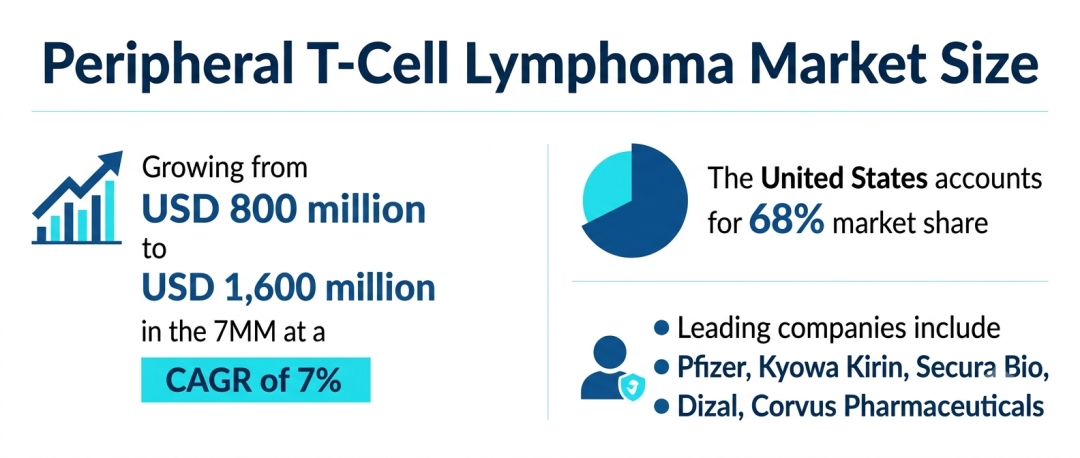
According to DelveInsight’s analysis, the PTCL market size was found to be USD 800 million in the 7MM in 2025, and it is projected to reach ~USD 1,600 million by 2036, growing at a CAGR of ~7% during 2026-2036.
-
The United States is expected to account for the largest share of the PTCL market, i.e., 68% by 2036 across the 7MM.
-
In the 7MM, ADCETRIS held the largest market share in 2025, generating over USD 300 million.
-
The US accounted for about 12,000 incident cases of PTCL in 2025, and this number is expected to increase by 2036.
-
CHOP remains the standard first-line therapy for PTCL, yet substantial unmet need persists for patients who cannot tolerate cytotoxic chemotherapy. ADCETRIS is the only approved first-line agent, reflecting limited therapeutic progress.
-
Japan serves as the primary hub for PTCL therapies, with the majority of treatment approvals concentrated in the country, reflecting both an advanced regulatory environment and a strong focus on addressing this rare and aggressive disease.
-
Despite recent advances, outcomes remain poor, especially in high-risk subtypes (PTCL-NOS, AITL/TFH), underscoring the need for biologically guided, safe, and effective therapies across both first-line and R/R settings.
-
The leading Peripheral T-Cell Lymphoma Companies include Pfizer, Kyowa Kirin, Citius Pharmaceuticals, Secura Bio, Shanghai YingLi Pharmaceutical, Dizal Pharmaceutical, Corvus Pharmaceuticals, and others.
-
Promising Peripheral T-Cell Lymphoma Therapies include Duvelisib (COPIKTRA), Lacutamab (IPH4102), Soquelitinib, Golidocitinib, Linperlisib, Tolinapant ± ASTX727, and others.
Get a Free sample for the Peripheral T-Cell Lymphoma Market Forecast, Size & Share Analysis Report @ Peripheral T-Cell Lymphoma Therapeutics Market
Peripheral T-Cell Lymphoma Overview
Peripheral T-cell lymphoma (PTCL) is a rare, heterogeneous group of aggressive T-cell lymphomas arising from clonal proliferation of dysfunctional T lymphocytes. It accounts for 10–15% of non-Hodgkin lymphomas (NHLs) in the US, 6.5% in the EU, and 25% in Japan, with PTCL-NOS, AITL, and ALCL being the most common subtypes. PTCL comprises ~19 nodal or systemic entities, including the aggressive adult T-cell leukemia/lymphoma (ATLL) associated with HTLV-1. Clinically, patients present with rapidly enlarging painless lymphadenopathy, systemic “B symptoms” (fever, night sweats, weight loss, pruritus), and, in advanced cases, cytopenias, bleeding, or hepatosplenomegaly. Molecularly, PTCL is driven by post-thymic genomic instability affecting T-cell differentiation, T-cell receptor signaling, epigenetic regulation, and immune checkpoints. Diagnosis remains challenging due to overlap with reactive, infectious, autoimmune, and other lymphoid conditions, requiring expert hematopathological evaluation for accurate classification and management.
Peripheral T-Cell Lymphoma Epidemiology Segmentation in the 7MM
-
Total Incident Cases of Peripheral T-Cell Lymphoma
-
Stage-specific Incident Cases of Peripheral T-Cell Lymphoma
-
Type-specific Incident Cases of Peripheral T-Cell Lymphoma
-
CD30 Expression-specific Incident Cases of Peripheral T-Cell Lymphoma
-
Line-wise Treated Cases of Peripheral T-Cell Lymphoma
Download the report to understand which factors are driving Peripheral T-Cell Lymphoma Epidemiology trends @ Peripheral T-Cell Lymphoma Prevalence
Peripheral T-Cell Lymphoma Epidemiology Key Findings
-
The US accounted for about 12,000 incident cases of PTCL in 2025.
-
Among EU4 and the UK, Germany accounted for the maximum number of PTCL cases (approx. 1,270), followed by France and the UK, in 2025.
-
PTCL is most frequently diagnosed at advanced stages (III/IV), reflecting both the aggressive biology of many subtypes and delays in early recognition due to its rarity and nonspecific symptoms. Stage IV often comprises the single largest group among incident PTCL diagnoses, while early-stage (I/II) disease remains a minority of cases.
-
Improved pathology standards and wider use of molecular diagnostics have reduced historical underdiagnosis and reclassified cases previously labeled as PTCL-NOS or other NHLs. An aging population and a higher prevalence of immune dysregulation further expand the pool at risk.
-
In the US, the major PTCL subtypes include PTCL-NOS, ALCL (ALK-positive and ALK-negative), AITL, nasal NK/T-cell lymphoma, enteropathy-type intestinal T-cell lymphoma, hepatosplenic T-cell lymphoma, and other rare entities.
-
In Japan, endemic HTLV-1 infection, particularly in southwestern Japan, directly increases the incidence of ATLL, a major PTCL subtype, while the country’s rapidly aging population further expands the high-risk age group.
Approved Therapies for Peripheral T-Cell Lymphoma
Approved agents for PTCL include HDAC inhibitors (e.g., romidepsin, belinostat), antifolates (pralatrexate), and antibody-based therapies such as brentuximab vedotin for CD30-expressing disease. Recently approved therapies include XALKORI (Pfizer; US: 2021, EU: 2024), HIYASTA (tucidinostat; HUYABIO; Japan: 2021), DARVIAS (darinaparsin; Solasia Pharma/Nippon Kayaku; Japan: 2022), and EZHARMIA (valemetostat tosilate; Daiichi Sankyo; Japan: 2022).
-
Valemetostat tosilate (EZHARMIA): Daiichi Sankyo
Valemetostat tosilate is a potentially selective first-in-class dual inhibitor of EZH1 and EZH2, designed to counter epigenetic dysregulation by targeting these enzymes. It is approved in Japan for the treatment of patients with relapsed or refractory PTCL and relapsed or refractory ATLL, and is an investigational medicine in all countries outside of Japan. In January 2024, Daiichi Sankyo submitted a supplemental NDA to Japan’s MHLW for valemetostat tosilate for the treatment of adult patients with R/R PTCL.
-
Crizotinib (XALKORI): Pfizer
Crizotinib is indicated for treating pediatric patients 1 year and older and young adults with R/R systemic anaplastic large cell lymphoma (sALCL) that is ALK-positive. In July 2024, the CHMP adopted an extension of crizotinib’s existing indications in ALK-positive ALCL and unresectable inflammatory myofibroblastic tumour (IMT) to include treatment of children from 1 year of age.
Peripheral T-Cell Lymphoma Pipeline Analysis
-
Duvelisib (COPIKTRA): Secura Bio
Duvelisib (COPIKTRA) is an oral inhibitor of phosphoinositide 3-kinase (PI3K), targeting the PI3Kδ and PI3Kγ isoforms. PI3K signaling may lead to the proliferation of malignant cells and is thought to play a role in the formation and maintenance of a supportive tumor microenvironment. In December 2025, Secura Bio announced that the Phase III TERZO study remains on track for an interim data readout in early 2027, based on enrollment to date.
-
Lacutamab (IPH4102): Innate Pharma
Lacutamab is a first-in-class anti-KIR3DL2 humanized cytotoxicity-inducing antibody. It is currently being investigated in an open-label, multicohort Phase II clinical study in CTCL and a Phase II study in PTCL. In December 2025, Innate Pharma announced that Phase II PTCL trial data is anticipated by the end of 2026.
Discover more about therapies set to grab Major Peripheral T-Cell Lymphoma Market Share @ Peripheral T-Cell Lymphoma Market Drivers and Barriers
Peripheral T-Cell Lymphoma Market Outlook
PTCL is a group of rare, aggressive, and highly heterogeneous malignancies with poor prognosis and limited treatment options compared with B-cell lymphomas. The current standard of care for initial treatment is multi-agent chemotherapy, which has not significantly changed in decades and too often fails to produce long-term remissions. In the first-line setting, treatment has shifted toward ADCETRIS combined with CHP for CD30-expressing PTCL, especially systemic ALCL, while CHOP or CHOP-like regimens remain standard for CD30-negative disease. Emerging therapies from companies such as Secura Bio (COPIKTRA), Dizal Pharmaceutical (golidocitinib), and Shanghai YingLi Pharmaceutical (linperlisib) are expected to mark a significant change during the forecast period. Future endeavors should focus on subtype-specific trials and novel combination therapies in the front-line setting. With a small, fragmented market, future success will favor therapies that demonstrate clear superiority over existing agents, biomarker-aligned positioning, and scalable commercialization strategies.
Peripheral T-Cell Lymphoma Treatment Landscape
Treatment of PTCL is guided by histologic subtype, stage, and patient fitness. For newly diagnosed nodal PTCLs, frontline treatment typically consists of anthracycline-based regimens such as CHOP or the brentuximab vedotin–containing BV-CHP for CD30-positive subtypes, particularly ALCL. Consolidation with autologous stem cell transplantation (ASCT) in first remission is commonly recommended for eligible patients. Relapsed or refractory PTCL remains challenging to treat, and management typically involves clinical trial participation or novel targeted and epigenetic therapies, with allogeneic stem cell transplantation considered in select patients with chemosensitive relapse. Key factors driving the market include rising PTCL incidence, growing opportunities in the R/R patient pool, and an emerging competitive landscape.
To know more about Peripheral T-Cell Lymphoma Companies working in the treatment market, visit @ Peripheral T-Cell Lymphoma Market Access and Reimbursement
Scope of the Peripheral T-Cell Lymphoma Market Report
-
Coverage- 7MM
-
Study Period- 2022-2036
-
Forecast Period- 2026-2036
-
Peripheral T-Cell Lymphoma Companies- Pfizer, Kyowa Kirin, Citius Pharmaceuticals, Secura Bio, Shanghai YingLi Pharmaceutical, Dizal Pharmaceutical, Corvus Pharmaceuticals, and others.
-
Peripheral T-Cell Lymphoma Therapies- FOLOTYN/DIFOLTA (pralatrexate), BELEODAQ (belinostat), ADCETRIS, Duvelisib, Tolinapant ± ASTX727, Golidocitinib, and others.
-
Peripheral T-Cell Lymphoma Market Dynamics: Peripheral T-Cell Lymphoma market drivers and market barriers
-
Peripheral T-Cell Lymphoma Competitive Intelligence Analysis: SWOT Analysis, Conjoint Analysis
-
Peripheral T-Cell Lymphoma Unmet Needs, KOL Views, Reimbursement
Table of Contents
-
Key Insights
-
Report Introduction
-
Executive Summary
-
Key Events
-
Epidemiology and Market Forecast Methodology
-
Peripheral T-cell lymphoma (PTCL) Market Overview at a Glance
-
Disease Background and Overview of Peripheral T-cell lymphoma (PTCL)
-
Epidemiology and Patient Population of Peripheral T-cell lymphoma (PTCL)
-
Patient Journey of Peripheral T-cell lymphoma (PTCL)
-
Marketed Therapies
-
Emerging Therapies
-
Peripheral T-cell lymphoma (PTCL): 7MM Analysis
-
Unmet Needs of Peripheral T-cell lymphoma (PTCL)
-
SWOT Analysis of Peripheral T-cell lymphoma (PTCL)
-
KOL Views of Peripheral T-cell lymphoma (PTCL)
-
Market Access and Reimbursement of Peripheral T-cell lymphoma (PTCL)
-
Appendix
-
DelveInsight Capabilities
-
Disclaimer
-
About DelveInsight
Media Contact
Company Name: DelveInsight Business Research LLP
Contact Person: Abhishek kumar
Email: Send Email
Phone: 09650213330
Address:304 S. Jones Blvd #2432
City: Las Vegas
State: NV
Country: United States
Website: https://www.delveinsight.com/sample-request/peripheral-t-cell-lymphoma-ptcl-market


