
Leading Oil-Based Emulsion Suppliers Drive Growth Across Global Markets
Foshan, Guangdong, China – October 22, 2026
The global Oily Based Emulsion market is expanding across cosmetics, pharmaceuticals, agriculture, coatings, and industrial formulations. Yet choosing a supplier requires more than comparing prices or production volumes. A reliable partner should demonstrate stable droplet control, repeatable viscosity, verified raw materials, and clear quality documentation. These details become visible during practical testing: a sample jar may show separation, uneven texture, or sediment after several weeks. Small signs matter.Professor David Julian McClements, a respected emulsion scientist, describes the technical challenge clearly: “Emulsions are thermodynamically unstable systems.” This statement explains why formulation expertise remains essential. Suppliers such as Croda, BASF, Evonik, Clariant, Lubrizol, Ashland, and Seppic have built strong international reputations through research, manufacturing capacity, and application support. However, reputation alone is not enough. Buyers should examine batch consistency, stability data, regulatory compliance, technical service, and regional delivery capabilities.Performance varies.A supplier may offer an impressive laboratory sample but struggle during full-scale production. Another may provide excellent stability but limited customization. This is where direct audits, pilot trials, and independent testing add practical confidence. The seven suppliers reviewed in this guide are assessed through these real-world considerations, rather than marketing language alone. Some rankings remain debatable, because application requirements differ between a lightweight cosmetic cream and a demanding industrial coating. That limitation deserves acknowledgment. Still, the comparison offers a useful starting point for procurement teams seeking safer, more consistent, and technically dependable Oily Based Emulsion solutions worldwide.
 What Are Oil-Based Emulsions and Where Are They Used?
Oil-based emulsions usually contain water droplets dispersed through a continuous oil phase. This structure is called water-in-oil, or W/O. It feels richer and slows water loss from skin. However, many suppliers use the phrase loosely. Some actually sell oil-in-water systems, where oil droplets float inside water. The label is still confusing.These emulsions support barrier creams, ointments, pigment dispersions, agricultural formulations, and selected food applications. In cosmetics, the oil phase can improve spreadability and protect moisture-sensitive ingredients. In pharmaceutical development, droplet size, viscosity, and storage stability require controlled testing. Grand View Research estimated the global emulsifiers market at about USD 9 billion in 2023, with continued growth through 2030. Mordor Intelligence also reported steady expansion, although market estimates differ by category and region. That difference deserves attention when comparing the best Oily Based Emulsion suppliers.Tips: Ask for droplet-size data, accelerated stability results, microbial specifications, and ingredient traceability. Request samples from different production lots. A smooth sample may still separate after heat exposure. I have seen formulation decisions rely too heavily on appearance. That is a weak test. Check viscosity at several temperatures, then review compatibility with packaging materials. Suppliers should explain their surfactant system, processing temperature, and batch controls. ISO-based quality procedures can strengthen supplier audits, but they do not replace application testing. A formulation that works in a laboratory jar may fail during transport.
7 Best Oily Based Emulsion Suppliers Worldwide? – What Are Oil-Based Emulsions and Where Are They Used?
A practical comparison of supplier categories, emulsion technologies, typical specifications, and major industrial applications
| Rank | Supplier Category | Typical Emulsion Type | Common Oil Phase | Typical Solids or Active Content | Main Industries Served | Key Selection Advantage | Typical Regional Availability |
|---|---|---|---|---|---|---|---|
| 1 | Specialty chemical emulsion suppliers | Oil-in-water or water-in-oil specialty emulsions | Mineral, vegetable, synthetic, or silicone oils | Typically 30–70% by weight, depending on the formulation | Coatings, adhesives, construction, textiles, and industrial processing | Custom formulation, application testing, and technical support | North America, Europe, and Asia-Pacific |
| 2 | Polymer emulsion manufacturers | Acrylic, styrene-acrylic, vinyl acetate, or polyurethane dispersions | Hydrocarbon, ester, or other organic oil-compatible phases | Commonly 40–60% polymer solids | Paints, printing inks, sealants, flooring, and packaging | Film formation, adhesion, gloss, flexibility, and chemical resistance | Global distribution through regional production networks |
| 3 | Agricultural formulation suppliers | Emulsifiable concentrates and oil dispersion systems | Vegetable oils, mineral oils, or biodegradable ester oils | Active ingredient levels vary widely by crop-protection product | Crop protection, adjuvants, seed treatment, and pest management | Improved spreading, wetting, mixing, and delivery of hydrophobic actives | Europe, the Americas, Asia-Pacific, and agricultural export markets |
| 4 | Cosmetic and personal-care emulsion suppliers | Oil-in-water creams, water-in-oil creams, lotions, and anhydrous systems | Plant oils, esters, hydrocarbons, silicones, or natural butters | Usually 5–40% oil phase in creams and lotions | Skin care, hair care, sun care, makeup, and dermatological products | Sensory performance, spreadability, stability, and regulatory documentation | Europe, North America, East Asia, and Southeast Asia |
| 5 | Food and beverage emulsion ingredient suppliers | Oil-in-water flavor, beverage, sauce, and nutritional emulsions | Edible vegetable oils, citrus oils, essential oils, or flavor oils | Often 1–30% oil phase, depending on the final food application | Beverages, sauces, dairy alternatives, supplements, and confectionery | Food-grade compliance, flavor protection, and controlled droplet size | North America, Europe, Asia-Pacific, and major food-processing regions |
| 6 | Pharmaceutical and medical formulation suppliers | Topical creams, lipid emulsions, injectable emulsions, and drug-delivery systems | Purified vegetable oils, medium-chain triglycerides, or pharmaceutical-grade lipids | Formulation-specific; sterile products require tightly controlled specifications | Topical medicine, parenteral nutrition, drug delivery, and medical devices | GMP systems, traceability, sterility options, and quality testing | Highly regulated markets in North America, Europe, and Asia |
| 7 | Lubricant and metalworking-fluid suppliers | Soluble oils, semi-synthetic fluids, and water-dilutable lubricant emulsions | Mineral oils, synthetic hydrocarbons, esters, or lubricating bases | Concentrates are commonly diluted with water before use | Machining, grinding, rolling, forming, corrosion protection, and maintenance | Cooling, lubrication, rust inhibition, foam control, and hard-water tolerance | Industrial markets worldwide, especially manufacturing regions |
What Are Oil-Based Emulsions?
Oil-based emulsions are mixtures in which oil is either dispersed in water as small droplets or used as the continuous phase containing dispersed water droplets. Their performance depends on the oil type, emulsifier system, droplet size, viscosity, pH, temperature stability, and intended application.
Important Data Note
The specifications shown are representative industry ranges rather than guaranteed values for a particular supplier or product. Actual requirements should be confirmed through technical data sheets, regulatory documents, compatibility testing, and application trials.
How to Evaluate Global Oil-Based Emulsion Suppliers
Selecting from the 7 Best Oily Based Emulsion Suppliers Worldwide requires more than comparing website claims. Evaluate production experience, formulation expertise, and quality systems together. Ask how many years the facility has handled similar emulsions. Request recent batch records, certificates of analysis, safety documents, and stability results. Check whether the supplier can control viscosity, particle size, odor, and separation across different batches. A sample may look excellent on day one, but heat and storage can reveal problems later.Tips: Request three production samples, not one. Test them under your actual temperature, mixing, and packaging conditions. Confirm minimum order quantities, lead times, filling options, and export documentation. For a china Oily Based Emulsion supplier, review factory traceability, equipment maintenance, and communication speed. A video audit is useful, but an independent inspection gives stronger evidence.Reliable suppliers explain limitations clearly. They should identify raw material changes before shipment and provide a corrective-action process. Compare technical responses, not only prices. A low quotation can hide weak testing or inconsistent packaging. One practical weakness deserves attention: buyers often approve samples too quickly. I have seen specifications accepted without checking long-term storage. That mistake can become expensive. Ask for customer references from comparable industries, while protecting confidential information. Keep every promise in writing. Trust still needs records.
How to Evaluate Global Oil-Based Emulsion Suppliers
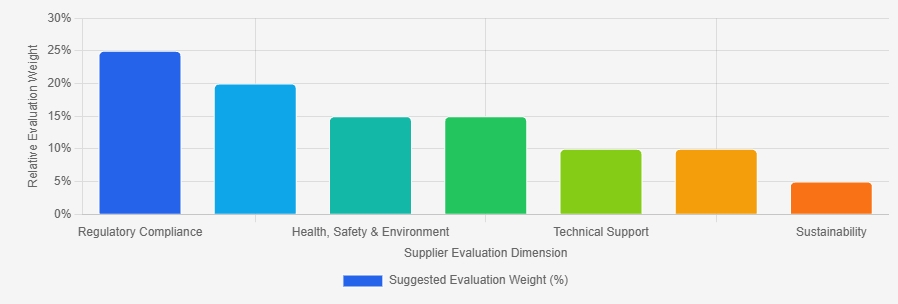
This suggested scorecard uses a 100-point weighting model for comparing oil-based emulsion suppliers. Regulatory compliance and emulsion performance receive the greatest emphasis because they directly affect product safety, consistency, and qualification risk. Buyers can adjust the weighting according to application, market, and supply-chain requirements.
Leading Oil-Based Emulsion Suppliers by Region
Regional sourcing matters when selecting oil-based emulsion suppliers.
Europe remains strong in specialty formulations, technical documentation, and regulated quality systems. The European Chemicals Agency requires extensive substance data under REACH, which makes traceability easier to verify. It can also increase lead times.
North American suppliers often emphasize customized viscosity, stability testing, and reliable batch records. The United States food and personal-care sectors continue supporting demand for functional emulsifiers. A 2024 report from Grand View Research projects the global emulsifiers market to expand at a steady compound annual growth rate through 2030. However, market estimates differ by product definition. Buyers should read the methodology, not only the headline figure.
Asia-Pacific offers broad production capacity and competitive wholesale pricing. China, India, South Korea, and Japan serve different needs, from high-volume industrial grades to refined cosmetic ingredients. The 2024 MarketsandMarkets assessment identifies Asia-Pacific as a major growth region for emulsifiers, supported by food processing and personal-care manufacturing.
For wholesale Oily Based Emulsion purchases, request recent certificate-of-analysis files, viscosity results, microbial limits, and sample retention records.
Suppliers in the Middle East, Africa, and Latin America can shorten regional delivery through local blending or storage. Yet port delays and inconsistent technical communication remain practical risks. A polished brochure is not proof. Small pilot batches reveal separation, odor changes, and pumping problems that laboratory sheets may miss.
Key Products and Formulation Capabilities to Compare7 Best Oily Based Emulsion Suppliers Worldwide?
Key Products and Formulation Capabilities to Compare
Comparing seven global suppliers of oil-based emulsions requires more than checking catalog size. Product fit starts with emulsion type. Review water-in-oil systems, anhydrous creams, emulsified oils, and concentrated bases for your application. Ask for technical composition, viscosity ranges, oil-phase limits, preservative strategy, and recommended processing temperatures. Small details matter. Some suppliers offer ready-to-use bases, while others develop prototypes from a brief.
Request samples made at laboratory and pilot scale. Then compare texture, separation, odor, color, and filling behavior after storage. Heating a sample to 40°C can expose weakness that room-temperature testing misses. However, one accelerated test cannot predict every package interaction. Suppliers should also explain minimum order quantities, lead times, packaging options, and regional regulatory support.
Strong formulation capability includes high-shear equipment, homogenization control, and documented batch records. Technical teams should explain how droplet size, emulsifier choice, and oil polarity affect stability. Look for support with pH adjustment, active loading, fragrance compatibility, and scale-up troubleshooting. Reliable suppliers provide certificates, microbiological results, stability protocols, and change-control procedures. Claims should match evidence. Ask whether reports identify sample age, temperature, and container type. Cost still matters, but a low quote may hide minimum volumes or costly rework. On paper, a preferred supplier might not perform best after a failed pilot. Real production reveals the truth.
Quality Standards, Certifications, and Regulatory Compliance
Choosing among the seven best oily based emulsion suppliers requires more than comparing price or texture. Quality begins with a documented management system. The ISO Survey 2022 recorded over 1.26 million ISO 9001 certificates worldwide, yet certification alone does not prove product suitability. Ask for batch records, raw-material traceability, deviation reports, and recent audit findings. Small details matter, such as sealed drums, temperature logs, and clear lot numbers.
For cosmetic applications, ISO 22716 certification indicates structured Good Manufacturing Practices. Suppliers should also provide stability data, microbial results, allergen information, and complete ingredient documentation. Under European cosmetic rules, every ingredient and safety claim must support the finished product’s compliance. For pharmaceutical or medical applications, stronger controls may include GMP evidence, validated methods, and change-control procedures. The WHO Technical Report Series emphasizes documented risk management, contamination control, and consistent production practices.
A supplier may present impressive certificates. Still, certificates can expire, and audits may reveal gaps. Request current documents, not scanned files from several years ago. Compare test methods, acceptance limits, and corrective-action records across suppliers. The FDA’s annual quality and compliance publications repeatedly show that weak documentation remains a common inspection concern. This is easy to underestimate. A dependable supplier should explain failures openly, support regulatory questions, and demonstrate repeatable emulsion performance across multiple batches.
Pricing, Supply Capacity, and International Distribution Factors
Selecting the seven best oily based emulsion suppliers requires more than comparing catalogue prices. A reliable review should examine raw-material sourcing, batch consistency, technical support, and export experience. The World Bank’s Commodity Markets Outlook, October 2024, projected broad commodity prices to decline in 2025, but vegetable oils remain exposed to weather and crop changes. Therefore, a supplier’s price should include oil-index formulas, minimum order quantities, packaging, testing, and currency exposure.Supply capacity needs physical evidence. Ask for monthly output, reserve capacity, lead times, and recent batch records. A plant offering 500 tonnes monthly may still struggle during seasonal demand spikes. It happens. Audit reports, ISO-based quality systems, stability data, and retained samples provide stronger proof than sales claims. For a custom Oily Based Emulsion, confirm viscosity, droplet size, preservative performance, and shelf life before signing a volume contract.International distribution can change the final cost sharply. UNCTAD’s Review of Maritime Transport 2024 reported that global maritime trade grew 2.4% in 2023, while rerouting and port disruptions increased transit uncertainty. Suppliers near deep-water ports may offer better freight options, but inland delivery can erase that advantage. Compare delivered-cost quotations across at least two routes. Check temperature requirements, customs documents, insurance, and backup warehouses. Some buyers focus too heavily on unit price; that is a costly blind spot.
Professional Water-Based Digital Transparent Printing Paste: China Factory Suppliers and Screen Printing Solutions
China Factory Suppliers of Professional Water Based Digital Transparent Printing Paste for Screen Printing
Professional water-based digital transparent printing paste is designed for screen printing applications that require clarity, layering, and refined visual effects. Produced by experienced China factory suppliers, this transparent paste offers smooth application, reliable consistency, and excellent compatibility with a range of printing workflows. Its water-based formulation supports efficient handling while helping create clean, translucent finishes on suitable textiles and decorative surfaces.The paste is particularly useful for multi-layer screen printing, allowing designers to overlay transparent areas with other colors without completely hiding the underlying artwork. It can also be applied to create soft highlights, depth, subtle textures, and distinctive visual transitions in creative designs. With its flexible performance, this digital transparent paste serves artists, printers, and product developers seeking professional screen printing solutions for customized projects. Careful production and quality control help maintain stable color interaction, even coverage, and dependable results across different applications.
Conclusion
Oily Based Emulsion refers to a formulation in which oil droplets are dispersed within a continuous phase, creating products with specific texture, stability, moisture retention, and performance characteristics. These emulsions are used across personal care, cosmetics, food-related applications, coatings, agriculture, and selected industrial processes. Choosing a suitable supplier requires evaluating emulsion type, raw material quality, formulation expertise, production consistency, technical support, and the ability to customize products for different applications.A reliable global supplier should demonstrate appropriate quality systems, transparent testing procedures, relevant certifications, and compliance with applicable safety and labeling requirements in target markets. Buyers should also compare product stability, shelf life, packaging options, minimum order quantities, pricing, production capacity, lead times, and international distribution capabilities. Regional supply strength, communication efficiency, documentation, and contingency planning are equally important when assessing long-term cooperation. By comparing these factors systematically, companies can identify suppliers that offer dependable quality, scalable production, regulatory confidence, and practical support from product development through delivery.
About Us
Foshan Sophah Screen Printing Technology Co., Ltd. is a modern new-type silkscreen material corporation integrating band production and trading together. Our company was founded in 1987. During the struggle of our staff, our company has become the most sweeping corporation of selling silkscreen material.At first, our company was just engaged in silkscreen materials from different countries.
Media Contact
Company Name: Foshan Sophah Screen Printing Technology Co., Ltd.
Contact Person: Media Relations
Email: Send Email
Country: China
Website: https://www.sophah-chemical.com/


