
Comprehensive Guide Identifies the Best Performing Wall Cladding Panels on the Market
Guangzhou, Guangdong, China – October 27, 2026
So, picking the right wall cladding panels? It’s not just about comparing colors, textures, or how much they cost in the showroom. A wall system has to hold up—really hold up—under rain, sunlight, shifting temperatures, impacts, and the demands of everyday upkeep. And here’s something worth keeping in mind: according to the 2024 Global Status Report for Buildings and Construction from UNEP and the Global Alliance for Buildings and Construction, buildings use around 32% of the world’s energy and generate roughly 34% of global carbon emissions. So yeah, in that kind of context, material efficiency, how long the cladding lasts, and whether it’s sourced responsibly all become pretty important when you’re deciding on cladding.And honestly? Real projects are where you actually see the difference.So, fiber cement, metal, natural stone, brick slips, and wood-plastic composite panels—each one solves a different kind of problem. Fiber cement, for instance, can offer solid dimensional stability and help keep maintenance low. Metal panels give you clean detailing and plenty of design flexibility. WPC systems can imitate timber while meaning less repainting, but you still need to carefully weigh moisture movement, fire performance, and fixing quality. Okay, so the search phrase Wall Cladding Wpc Wall Cladding might sound a bit repetitive. But honestly? It speaks to something buyers really care about: whether WPC is actually the right fit for a certain wall, climate, and building use.Grand View Research and Fortune Business Insights both point to the same trend: construction materials and façade systems keep growing. Renovation, energy efficiency, and urban development are the big drivers. But just because a market is growing doesn’t mean one panel is the best choice everywhere. Datasheets? They can conveniently skip over installation headaches. I’ve seen good-looking façades fail because of poor drainage and not enough expansion gaps. That’s a lesson worth remembering.So, this guide is going to walk you through how Wall Cladding Panels stack up against each other—covering durability, looks, fire resistance, environmental impact, how tricky they are to install, and what they cost over their lifetime. Before you choose a system, though, make sure you check your local building codes, tested assemblies, warranties, and any third-party certifications. And honestly? A lot of it really comes down to the details.
 What Are Wall Cladding Panels and How Do They Work?
Wall cladding panels are protective, decorative layers fixed over a building’s structural wall. They do not usually carry the building’s main load. Instead, they manage rain, sunlight, impact, and surface wear. A typical system uses panels, rails or battens, fasteners, joints, and a ventilated cavity. Water reaches the outer face, then drains behind the panel. Airflow helps the wall dry.Panel performance depends on the material and installation. Fiber-cement panels resist moisture and fire well, while metal panels offer low weight and long service life. WPC panels combine wood fibers and polymers, creating a textured surface with limited routine painting. Search terms such as WPC Wall Cla Wall Panels for Outdoor usually describe exterior composite applications. However, “water-resistant” does not mean waterproof. Poorly sealed joints still invite staining and decay.The International Energy Agency reported that buildings accounted for about 30% of global final energy use in 2022. This makes the wall assembly important, not just its visible finish. A drained cavity, continuous insulation, and careful thermal-bridge control can reduce heat transfer. UNEP’s 2023 Global Status Report also linked buildings with roughly 37% of global energy-related emissions. These figures support performance-led choices. Still, product labels can oversimplify things. Check fire classification, impact resistance, moisture movement, and fastener spacing against local standards. A beautiful panel can fail when expansion gaps are ignored. That detail is easy to miss.
What Is the Best Type of Wall Cladding Panels? – What Are Wall Cladding Panels and How Do They Work?
Comparison guide: actual performance depends on the specific product, installation system, substrate, climate, and applicable building regulations.
| Panel Type | Typical Composition | Common Applications | Main Advantages | Key Limitations | Maintenance Profile | Relative Cost | Overall Suitability |
|---|---|---|---|---|---|---|---|
| Fiber Cement Panels | Cement reinforced with cellulose fibers, mineral fillers, and water | Exterior façades, rainscreen systems, balconies, and ventilated façades | Durable, dimensionally stable, resistant to moisture and ultraviolet exposure, and available in textured or smooth finishes | Heavier than many alternatives; cutting can generate respirable dust; edges require careful handling | Low to moderate | Moderate | Excellent for durable exterior cladding when properly detailed and installed |
| High-Pressure Laminate Panels | Resin-impregnated cellulose layers compressed under heat and high pressure | Commercial façades, educational buildings, balconies, and feature walls | Wide range of colors and wood-look finishes, good impact resistance, and relatively simple panel replacement | Performance varies by grade; exposed edges and joints need correct detailing; combustible formulations exist | Low | Moderate to high | Good for design-focused façades where the specified fire classification is suitable |
| Metal Composite Panels | Two metal skins bonded to a lightweight core | Commercial buildings, retail façades, entrances, soffits, and signage backgrounds | Lightweight, flat, easy to fabricate, and available in many colors and surface finishes | Thermal movement, denting, galvanic corrosion, and fire performance depend strongly on the core and assembly | Low to moderate | Moderate to high | Useful for lightweight architectural façades when the complete assembly meets local fire requirements |
| Solid Metal Panels | Single sheets of aluminum, steel, zinc, or other architectural metals | Modern façades, roofs, parapets, soffits, and high-detail architectural features | Long service potential, recyclability for many metals, crisp detailing, and strong resistance to impact depending on gauge | Can be relatively expensive; metals expand and contract; some finishes may show scratches or weathering | Low | High | Excellent for premium façades requiring precise detailing and a long-lasting appearance |
| PVC or Vinyl Panels | Rigid polyvinyl chloride, often formed into lightweight profiles or sheets | Interior feature walls, utility areas, soffits, and selected residential exterior applications | Lightweight, moisture resistant, easy to clean, and generally simple to install | Can discolor or become brittle with ultraviolet exposure; thermal expansion must be allowed for; fire properties vary | Low | Low to moderate | Suitable for cost-sensitive or moisture-prone areas when the product is rated for the intended location |
| Wood and Thermally Modified Wood Panels | Natural timber or timber treated with controlled heat to reduce moisture-related movement | Residential façades, hospitality projects, interiors, soffits, and accent walls | Natural appearance, renewable material options, tactile warmth, and good design flexibility | Requires moisture management; untreated or lightly finished wood can weather, fade, or require refinishing | Moderate to high | Moderate to high | Best where natural aesthetics are important and scheduled inspection and finishing are acceptable |
| Brick or Terracotta Panels | Fired clay units or thin clay-based panels fixed to a backing or support system | Exterior façades, civic buildings, residential developments, and heritage-inspired designs | Durable appearance, strong color stability, resistance to ultraviolet exposure, and a masonry-like finish | Heavier than many panel systems; support, drainage, movement joints, and installation tolerances are important | Low | Moderate to high | Excellent for robust façades with a traditional or masonry appearance |
| Natural Stone Panels | Thin slabs or engineered support-backed pieces of stone such as granite, limestone, slate, or marble | Premium façades, entrances, public buildings, lobbies, and feature walls | Distinctive natural appearance, high perceived value, and good durability when the stone and anchoring system are correctly selected | Heavy, comparatively costly, and sensitive to staining or weathering depending on the stone type | Low to moderate | High | Best for premium projects with adequate structural support and specialist installation |
| Glass Panels | Tempered, heat-strengthened, laminated, or insulated architectural glass | Feature façades, curtain wall zones, lobbies, partitions, and daylight-focused interiors | Excellent light transmission, visual openness, smooth cleanable surfaces, and many translucent or colored options | Potential glare, heat gain, privacy concerns, breakage risk, and higher cleaning requirements in exposed locations | Moderate to high | High | Effective where daylight, transparency, or a contemporary appearance is a primary design goal |
| Acoustic PET Panels | Compressed polyethylene terephthalate fibers, often made partly from recycled material | Offices, classrooms, recording spaces, restaurants, and interior feature walls or ceilings | Lightweight, easy to cut, available in decorative forms, and capable of reducing reverberation when correctly specified | Primarily an interior product; acoustic results depend on thickness, spacing, coverage, and room conditions | Low | Moderate | Excellent for interior acoustic treatment, but not a general substitute for exterior weather cladding |
Which Types of Wall Cladding Panels Are Available?
Wall cladding panels are available in several material families, and each suits a different room.
PVC panels resist moisture and clean quickly, making them practical for bathrooms and utility areas.
WPC panels offer a warmer grain pattern with better dimensional stability than ordinary timber. They still need careful sealing around cut edges.
That detail is often missed.
Wood veneer panels bring authentic texture, but sunlight can change their color and humidity may cause movement.
Metal panels, usually aluminum or steel, create crisp lines for commercial interiors and contemporary homes. They are durable, yet dents and fingerprints can remain visible.
Stone veneer panels provide a solid, tactile appearance without the weight of full masonry. Their joints must be planned around corners and outlets.
Fiber-cement panels handle impact and temperature changes well. Cutting them, however, creates dust, so proper ventilation and protective equipment are necessary.
For quieter rooms, acoustic PET or fabric-faced panels absorb reflected sound and soften hard surfaces. They suit offices, media rooms, and study spaces, but they cannot replace structural soundproofing.
Ceramic and porcelain panels offer strong moisture resistance and easy cleaning, although installation demands a level substrate.
In my view, the best choice depends on moisture, impact, maintenance, fire classification, and installation skill. A beautiful sample can disappoint when seams, expansion gaps, or lighting are ignored.
Measure twice. Then test one panel.
How Do Wall Cladding Materials Compare?
Choosing Wall Cladding Panels requires more than comparing appearance or purchase price. Fiber-cement panels offer strong fire resistance and stable dimensions, but cutting can create fine dust. Aluminum panels are lightweight and resist corrosion, while their production carries high embodied energy. The International Aluminium Institute reports that recycled aluminum requires about 5% of the energy used for primary aluminum production. That difference matters.
Terracotta provides color that remains stable under sunlight and rain. However, it is heavier and may increase structural demands. Timber cladding creates a warm, tactile surface, yet moisture detailing must be precise around window joints. A small installation error can cause swelling, staining, or hidden decay.
High-pressure laminate panels install quickly and offer many finishes, but damaged edges can be difficult to repair invisibly.
Energy performance deserves equal attention. The GlobalABC 2023 report states that buildings generated 37% of global energy and process-related emissions in 2022. Cladding does not solve operational energy use alone. A ventilated rainscreen, continuous insulation, and sealed junctions often matter more than the visible panel. Fire testing, service life, repair access, and local climate should shape the specification. EPD data can help, but comparisons remain imperfect because manufacturers use different boundaries and assumptions. That is easy to overlook. A low-carbon panel may perform poorly if it needs frequent replacement.
What Factors Determine the Best Wall Cladding Panel?
Choosing Exterior Wall Cladding Panels starts with the building, not a glossy sample. Climate is the first filter. Coastal air can accelerate corrosion, while freeze-thaw cycles expose weak joints. In hot regions, dark finishes absorb intense heat and expand. Wind exposure also affects fastening patterns and panel dimensions. A panel that performs well inland may struggle beside the sea. That distinction matters.The wall behind the cladding deserves equal attention. Masonry, concrete, timber, and framed assemblies require different fixings and drainage details. Check whether the system manages water behind the outer face. Moisture trapped around screws can cause staining, swelling, or hidden decay. Fire performance, impact resistance, acoustic needs, and insulation compatibility should be verified through documented testing. Ask for installation guidance, technical data, and evidence from comparable projects. Experienced installers often identify substrate movement before it becomes a visible crack.Maintenance changes the real cost. Smooth panels may rinse clean, but textured surfaces can hold dust near traffic routes. Consider access for inspection, replacement, and repainting where applicable. My first selection mistake was trusting a showroom sample; the full wall looked different under cloudy daylight. A small mock-up would have revealed it. Review color changes, joint alignment, edge protection, and thermal movement on site. No panel is perfect. The best choice balances appearance, service life, repairability, budget, and local workmanship. Recheck the details.
What Determines the Best Wall Cladding Panel?
Practical selection weighting for comparing wall cladding performance, safety, cost, and long-term value.
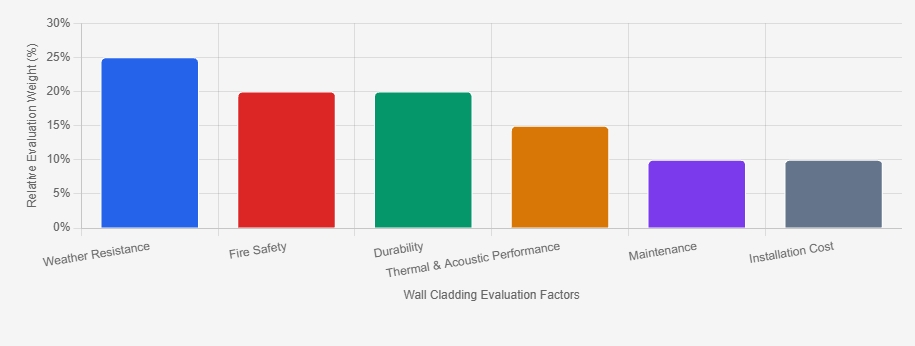
The best wall cladding panel depends on the building environment and project priorities. Weather resistance and fire safety receive the highest weighting because they directly affect building protection and service life. Durability, thermal and acoustic performance, maintenance needs, and installation cost should also be evaluated before making a final selection.
How Should Wall Cladding Panels Be Installed?
The best wall cladding panel depends on moisture, impact, and the room’s purpose. However, even excellent panels can fail when installation is rushed. A clean, stable wall is essential. Remove loose paint, repair cracks, and check for damp areas before measuring. Moisture behind panels can cause staining, swelling, or mold.
Allow the panels to adjust to the room for at least 24 hours. Mark a level starting line, because floors are rarely perfectly straight. Install battens when the wall is uneven or ventilation is needed. Keep small expansion gaps at edges and around corners. Use suitable adhesive, screws, or clips according to the panel material and installation guide. Press each panel firmly, but do not force tight joints. That mistake is easy to make. Leave space around pipes, sockets, and door frames. Seal wet-zone joints with a compatible sealant, while preserving any required ventilation gaps. Wear eye protection when cutting panels, and use a fine-tooth blade for cleaner edges.
Tips: Measure twice, then cut once. Keep the first panel perfectly level; later panels will follow it. Test adhesives on a hidden section first. I have seen neat installations fail because the wall was dusty or slightly damp. Recheck alignment after every few panels. Small corrections are much easier early. For bathrooms or exterior walls, confirm the substrate, drainage, and local installation requirements before fixing the final panel.
How Can Wall Cladding Panels Be Maintained and Replaced?
Maintaining wall cladding panels starts with controlling water, movement, and dirt. A small open joint can admit rain behind the surface. Inspect joints, corners, flashings, and fasteners every spring and after severe storms. Look for swelling, staining, loose panels, cracked sealant, or soft substrate. These signs often appear before visible panel failure. The 2024 Global Status Report for Buildings and Construction states that buildings consume 32% of global energy and create 34% of global carbon emissions. Proper maintenance reduces premature replacement and protects operational efficiency. Outdoor Wall Cladding Panels should also be cleaned with manufacturer-approved methods. Avoid aggressive pressure washing. It can damage coatings and force water into seams.
Replacement should begin with diagnosis, not appearance. Remove a small panel carefully and check the sheathing, insulation, membranes, and framing behind it. If moisture remains, replacing only the visible panel may repeat the problem. The U.S. Department of Energy reports that air leakage can account for 25–40% of heating and cooling energy use in typical homes. Therefore, replacement work should restore airtight layers and inspect insulation continuity. Match the new panel’s thickness, movement allowance, drainage path, and fire-performance requirements. Keep spare panels from the original installation when possible. Color changes over time are real. A perfect-looking patch may still be visibly different. I would document every repair with photographs, dates, weather conditions, and measured damage. That record supports safer decisions, although it cannot replace an experienced site inspection.
Conclusion
Wall Cladding Panels are protective and decorative surfaces installed over exterior or interior walls to improve appearance, durability, insulation, and resistance to moisture or impact. They are available in materials such as metal, wood, fiber cement, stone, ceramic, composite, and plastic, with each option offering different levels of strength, maintenance needs, cost, fire resistance, and weather performance. The best choice depends on the building’s location, design requirements, climate, budget, structural conditions, and expected service life.Proper installation requires accurate measurements, a suitable supporting structure, correct spacing, secure fastening, and attention to ventilation and moisture control. Professional installation can help prevent movement, water penetration, and uneven finishes. Regular maintenance should include cleaning, checking joints and fasteners, repairing surface damage, and replacing panels that are severely worn or compromised. By comparing materials and considering long-term performance rather than appearance alone, property owners can select wall cladding that is practical, attractive, and suitable for their specific project.
About Us
HOYEAH is a leading manufacturer specializing in the production of eco-friendly high-end wood-plastic composite (WPC) products.
Leveraging cutting-edge material technology, the company delivers sustainable solid wood alternatives that seamlessly combine the aesthetic appeal of natural wood grain with superior weather resistance.
Media Contact
Company Name: Guangzhou Hoyeah Composite Materials Co., Ltd
Contact Person: Media Relations
Email: Send Email
Country: China
Website: https://www.hoyeahchina.com/


